Where the Living Meet the Dead
In Romerillo, Chiapas, the dead don’t sleep in silence. They rest among music, laughter, and the scent of marigolds. I went there during Día de los Muertos, or J-k’in Anima in Tzotzil Maya, expecting reverence but found something far deeper: a living conversation with death.
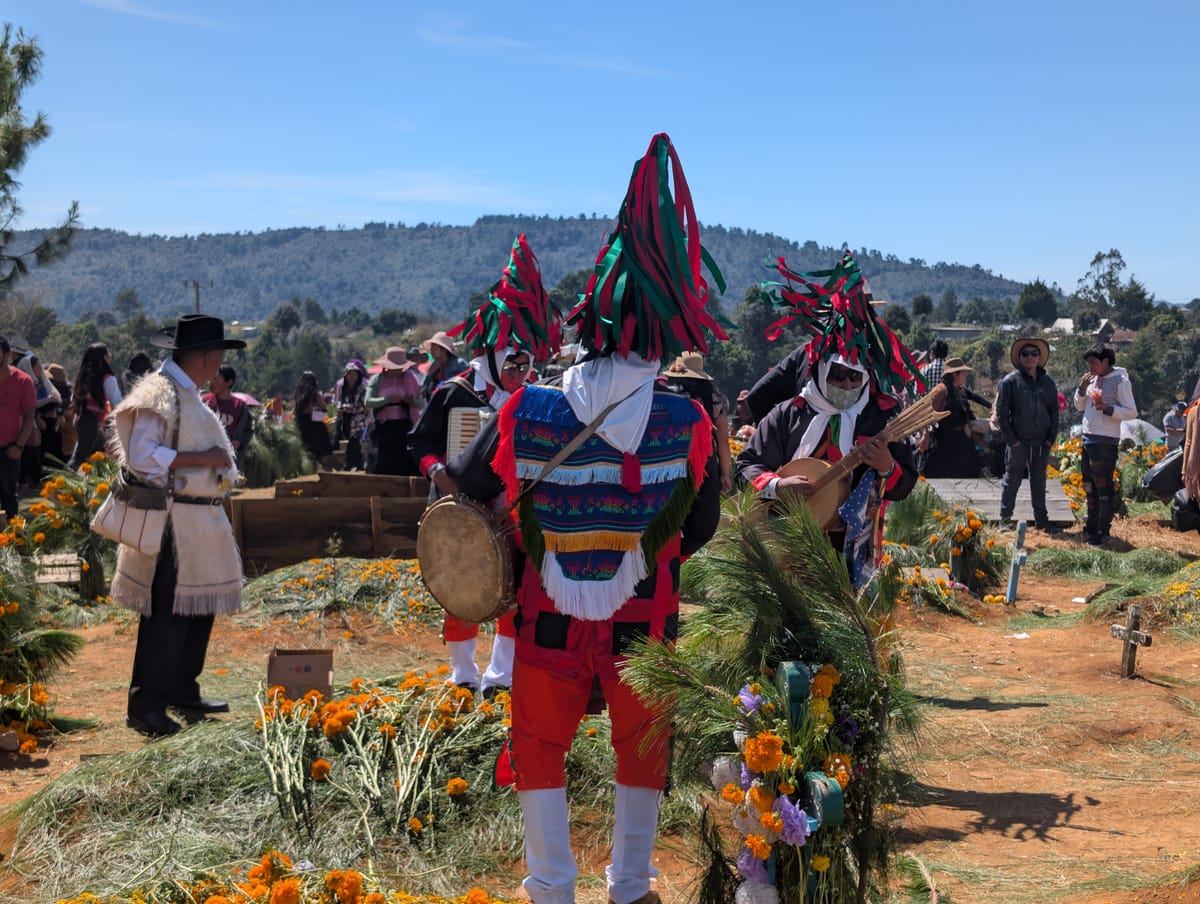
The cemetery stretched across the hillside, bright under the mountain sun. Graves were covered in pine needles, orange marigolds, and offerings like bottles of Coke, plates of food, and flickering candles. Families sat close, eating, singing, brushing pine over the mounds as if tucking in their loved ones for a visit. Small fires burned on top of the graves, smoke drifting upward like messages. I learned that the flames help guide the spirits home, their warmth nourishing the journey between worlds.
Musicians gathered in small circles across the cemetery, dressed in black wool tunics and bright woven shawls, their headdresses bursting with ribbons of red, green, and yellow that flickered in the sun. Some played accordions and guitars, others held wooden flutes carved by hand, their melodies weaving through the air like prayers. The sound was both ancient and alive, a rhythm meant for both the living and the dead. The music didn’t mourn, it danced.
A young woman approached my friends and me, shy but curious, and asked for a photo. She said she had never seen women like us before. It was a gentle, human exchange, two worlds meeting and both marveling at the other.
I thought of my grandmother in the cemetery. She was diagnosed with breast cancer at thirty-six, two years younger than I am now. I never met her, but she has always felt close, like a voice that visits in dreams when I need her most. She lived until my mother was seventeen, only fifty-two when she passed. I’ve always carried that awareness of mortality, its quiet ticking beneath everything. Since my mid-twenties I’ve gone through mammograms and genetic screenings, knowing both my grandmothers faced cancer young.
In 2024 they found a questionable mass on one of my scans, and I had to undergo an MRI-assisted biopsy. The entire experience was terrifying, but I found strength thinking of my grandmother, and I fell back on the philosophies that have always guided me - Buddhism, Taoism, the belief that life and death flow into one another like water and air. Being here in Mexico, learning about the Maya and their ancient rituals, has widened that perspective even more. Death isn’t feared here; it’s acknowledged, honored, even invited to the table. It’s made me realize how my own culture hides from death, wrapping it in silence and sorrow, while the Tzotzil people meet it with color, music, and reverence.
When we left, I kept thinking about how different this was from the Western way of death, how here it wasn’t hidden or hushed. It was honored. The living and the dead shared space, food, and laughter, reminding me that remembrance isn’t about grief. It’s about continuity.
Maybe death isn't a wall at all. Maybe it's a thin veil, a breath we share with those who came before us, carried on the scent of marigolds and smoke.